


Leading the Future in Sustainability and Responsible Growth

Background
Ulster University, named University of the Year 2024 at the Times Higher Education Awards, was recognised as a “force for good in fostering peace, prosperity, and cohesion.” Ulster University supports the UN Sustainable Development Goals and remains committed to driving positive change locally and globally. Through world-class education, cutting-edge research, strategic collaboration, and impactful community outreach, Ulster continues to lead as a responsible and forward-thinking institution.
What Ulster University did
Ulster University is a leader in environmental sustainability, driving impactful change in local communities, in wider Northern Ireland and beyond. It is committed to managing its environmental footprint while empowering students, staff, and businesses to be beacons of positive change.
All curriculums have sustainability embedded within them to transform awareness into action, equipping graduates with the expertise to shape a more resilient, responsible, and prosperous future. Ulster is committed to integrating Education for Sustainable Development (ESD) into the curriculum as part of its approach to Academic Excellence. An ESD Working Group aims to link learning, teaching, and research to the UN Sustainable Development Goals.
Ulster’s research informs policy on climate resilience, biodiversity, and renewable energy, ensuring that its expertise translates into real-world impact. By placing sustainability at the heart of its mission, the university is not only shaping a low-carbon future but also strengthening the social and economic fabric of the region.
Ulster University is a proud participant in the Net Zero Challenge, a cutting-edge digital sustainability platform that empowers students and staff to drive meaningful change. This prestigious initiative incentivizes bold action for staff and students; whether mastering carbon literacy, embracing active travel, reducing meat consumption, or tackling litter head-on. The community is leading the charge toward a more responsible future, earning green points and securing rewards along the way.
Their commitment is backed by significant investment in cutting-edge green infrastructure. All new capital building developments are built to BREEAM Excellent environmental standard and two 800kW wind turbine units generate 17% of the university’s electricity. There are five existing solar power systems with future schemes being explored. Each campus has extensive cycle parking facilities and regular travel initiatives to encourage cycling and walking as preferred travel options to campus. The university operates a number of fully electric maintenance and estates patrol vehicles and has developed an Electric Vehicle Infrastructure strategy to consider the campus infrastructure requirements to support and encourage the transition to electric vehicles.
Accredited to ISO14001 Environmental Management System standards, the university’s Estates and Procurement teams drive sustainability on its campuses and with an extensive supply chain, support local businesses while reinforcing ethical and environmental responsibility.
Ulster University’s commitment to sustainability extends far beyond its own operations, actively driving positive change within communities, businesses, and the wider Northern Ireland economy. Through strategic partnerships, outreach programmes, and knowledge exchange, the university empowers local organisations to adopt more sustainable practices, supporting their transition to greener business models.
Their engagement with schools and community groups fosters environmental awareness and action at all levels of society.
As a forward-thinking institution, Ulster aligns its sustainability approach to the UN Sustainable Development Goals, ensuring that its research, education, and operational excellence tackle global challenges. Through its Sustainable Futures for All: People, Place and Partnership Strategic Plan, the university is shaping a generation of sustainability leaders and change makers.
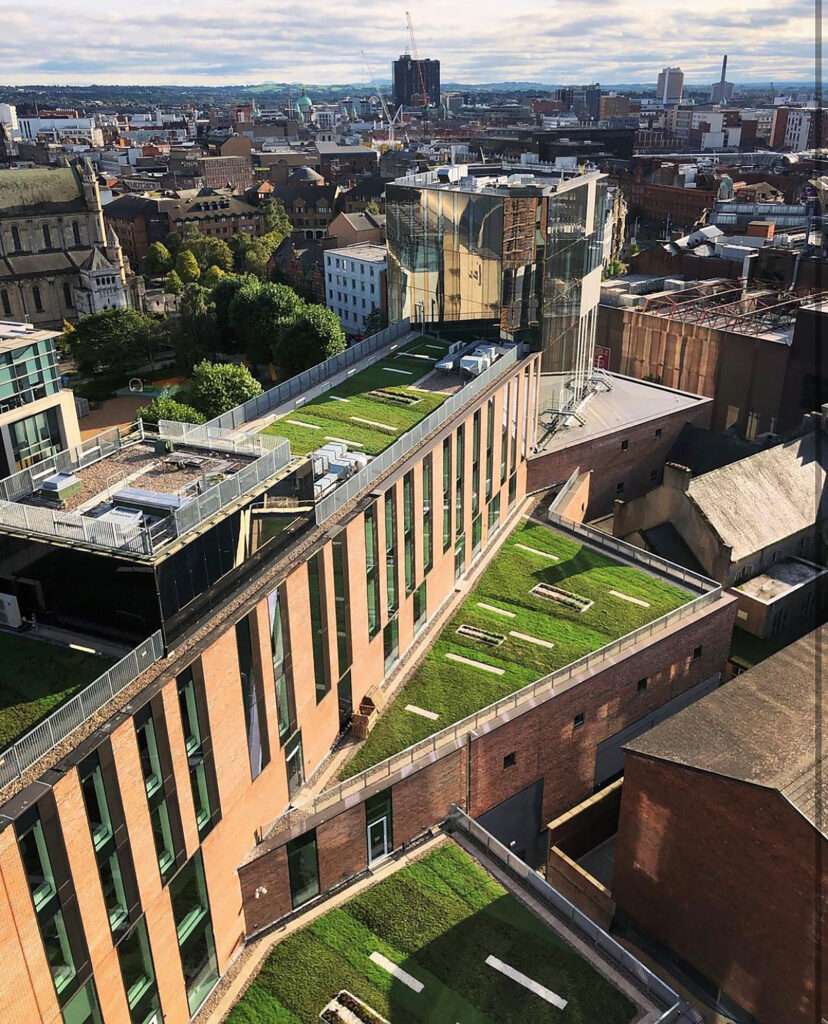
Belfast campus – green roofs.
Impacts and Outcomes
- The university has enhanced its Sustainability Team with the appointment of a Dean of Sustainability and Corporate Social Responsibility, Head of Sustainability, Sustainability Data and Information Officer and Sustainable Procurement Officer further strengthening the Education for Sustainable Development and Estate Services sustainability roles.
- A double materiality assessment was undertaken to better understand what sustainability means to the university and its stakeholders. This identified key sustainability topics and classified these into a priority matrix indicating high or low materiality, with skills and carbon emissions identified as two of the most material topics.
- Ulster University and its Students’ Union have earned the prestigious Responsible Futures Accreditation from Students Organising for Sustainability UK, for the institution’s commitment to embedding sustainability across teaching and learning. The student-led audit evaluated and highlighted initiatives to integrate sustainability into the curriculum, including mandatory training for new educators and the appointment of dedicated sustainability staff. This achievement reinforces Ulster’s role in shaping a greener, more responsible future.
- A consortium led by Ulster University secured £4.625m in funding from the Arts and Humanities Research Council for one of four new ‘Green Transition Ecosystems’ across the UK. On Rathlin Island the Future Island-Island project’s focus is on managing their specific waste types alongside the development of digital heritage and sustainable tourism applications.
- The university has made excellent progress in reducing campus operational carbon emissions (Scopes 1 & 2) to date, reducing from 19,889 tCO2e in 2005/06 to 7,754 tCO2e in 2023/24 and exceeding the target within its last carbon management plan.
- The University has completed a carbon emission (Scope 1, 2 and 3) baseline assessment that has identified its baseline emissions as 99,473 tCO2e, with Scope 3 emissions accounting for 90% of total emissions.
- The emissions baseline provided the foundation for the university’s approach to climate mitigation and adaptation action planning.
- From the baseline assessment the university identified the top three Scope 3 emissions as Purchased Goods and Services including Construction, Staff & Student Commuting and Business Travel. The university is implementing improvement plans to drive down emissions in these activity areas.
- Ulster University are engaged in a Higher Education sector pilot of a Net Zero Carbon Supplier tool which aims to decouple supply chain emissions from expenditure and utilise supplier carbon emissions to calculate scope 3 supply chain emissions. The project is at initial stages with those suppliers that currently hold an existing contract with Ulster invited to submit their scope 1 and 2 emissions data on the tool.
- The university is in the process of developing a consolidated travel plan to cover all campuses and a Sustainable Travel for Business Review Group has been established to design a set of business travel principles to reduce carbon emissions associated with business travel.
- The Net Zero Challenge with staff and students has now delivered over 10,000 impactful sustainability actions, instilling a culture of sustainability.
Link to website: https://www.ulster.ac.uk/sustainability
Contact : [email protected]
To find out more about taking part in the NI Environmental Benchmarking Survey, visit www.bitcni.org.uk/niebs.