

In turbulent times, with economic and environmental pressures, Finnebrogue is driving operational and supply chain resilience through sustainability.
About the company
Finnebrogue, part of the Sofina Foods Group, is one of the UK and Ireland’s leading food producers. Renowned for pioneering bacon and ham made without nitrites, crafting premium pork sausages, and developing innovative vegetarian ranges, the company continues to set new standards in quality and innovation from its four sites in Downpatrick.

The issue
For Finnebrogue, sustainability and resilience in food production go hand in hand. In their words, “the food industry is fundamentally dependent on the natural world – from how and where crops are grown and how livestock are reared, to the materials Finnebrogue use for packaging and the transport systems that move ingredients and products across the supply chain. Every link in the chain depends on natural resources and healthy ecosystems”.
When negative environmental impacts increase and biodiversity declines, supply chain resilience also declines. With increased climate-related impacts, supply chains become more vulnerable to shocks, leading to reduced yields and resource insecurity, which can ultimately translate into higher raw material costs and commercial risk.
At Finnebrogue, sustainability is viewed not just as a moral or environmental responsibility, but as a core business strategy for long-term success. The company’s approach is to collaborate closely with their suppliers and partners to minimise environmental impacts, protect and restore natural systems, and strengthen the overall resilience of the food industry. By investing time and resource into protecting people and planet, Finnebrogue safeguard the stability, affordability, and quality of food production for the future.
What Finnebrogue did
With rising energy costs, unpredictable climate conditions for food production, and evolving sustainability regulations, Finnebrogue recognised the clear overlap between strengthening the sustainability of their operations, and improving resilience.
In 2023, Finnebrogue embedded resilience into its core organisational strategy through its Bigger Picture programme – a company-wide sustainability strategy designed to protect nature, reduce environmental impacts, promote ethical sourcing, and future-proof operations. This has involved aligning sustainability objectives across various departments and operational functions, while making data-driven decision-making central to strategy.
The foundation for this resilience began with the Drive for Data, which included conducting a full sustainability materiality assessment, to understand the most salient environmental and social impacts affecting the business. Finnebrogue identified the following areas where they have the potential to make the biggest impact: Energy & Decarbonisation; Sustainable Sourcing; Waste & Water Reductions; Employee Health & Wellbeing; Ethical Trading; and Supporting Local Communities.
For each focus area, the associated environmental and social risks were integrated into the company’s Risk Register and KPIs were developed to measure and monitor improvements. The company also expanded their carbon accounting beyond scope 1 and 2 emissions to include scope 3 – the most complex and impactful area of the business’s footprint. By understanding where the greatest risks and opportunities lie, Finnebrogue has been able to build a proactive roadmap to strengthen both its own operations and those of its suppliers.
Finnebrogue’s approach was to improve resilience in two workstreams. One, by improving the sustainability of its operational sites, and two, by improving the sustainability of its supply chains.
On the operational side, Finnebrogue has strengthened its operational resilience through major investments in energy efficiency and renewable generation. In addition to the solar array at its main sausage manufacturing site, nearly 3,000 solar panels have been installed at their vegetarian site, generating more than 1.2 million kWh of renewable electricity each year. By reducing reliance on fossil fuels and increasing energy independence, the company has not only reduced its carbon footprint but also significantly lowered its exposure to energy price volatility. Across its operations, Finnebrogue has implemented a series of upgrades to cut energy use and carbon emissions – optimising compressor performance, improving insulation on heat exchangers and hot water systems, and replacing outdated equipment with more efficient alternatives.
At the main sausage site, these improvements have delivered measurable results. Between 2023 and 2024, gas oil consumption for the hot water boiler fell by 37%, reducing fuel costs while cutting carbon emissions by 192 tonnes. These savings were achieved through targeted actions such as lowering the hot water set point temperature, refurbishing their heat recovery system to maximise efficiency, and improving pipework insulation in line with ESOS audit recommendations. The electrification of the forklift fleet has further reduced emissions by 18 tCO2e per year. Overall, from 2022 to 2024 the company reduced its scope 1 & 2 carbon emissions by over 61%. Together, these measures demonstrate Finnebrogue’s data-driven approach to reducing energy consumption, strengthening resilience, and advancing its commitment to a low-carbon future.
Resilience through Sustainable Sourcing
The second key aspect was developing a framework for sustainable sourcing. Strong supply chain management has delivered tangible benefits for Finnebrogue – from improved risk management and supplier relationships, to cost savings and innovation. The company’s innovative Supplier Environmental and Social Assessment (SESA) has created visibility across the supply base, helping benchmark and track the sustainability performance of suppliers against key ESG criteria. The assessment includes questions related to whether suppliers have targets to reduce carbon emissions, waste, and water usage, as well as assess supplier policies on human rights, biodiversity and deforestation. This not only enables Finnebrogue to identify risks early but also to work collaboratively with suppliers to improve their performance over time.
Finnebrogue also launched the Supplier Engagement Team which has transformed how Finnebrogue interacts with its supply chain partners. A cross-departmental team, bringing together Procurement, Technical, Product Development and Sustainability team members, works closely with suppliers to meet sourcing standards, deliver sustainability training to suppliers, and recognise excellence through its recently launched Supplier Sustainability Awards. This multifunctional collaborative approach has built trust, increased transparency, encourages sustainable decision-making, and drives sustainable product development.
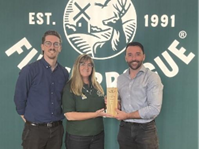
Finnebrogue presenting one of its suppliers with a Finnebrogue Supplier Sustainability Award
Externally, Finnebrogue’s partnerships with organisations such as the Agri-Food & Biosciences Institute (AFBI), Ivy Farms, and SeaFeed demonstrate the company’s commitment to advancing sustainable food production across the industry. These research partnerships focus on exploring topics including low-carbon pork, cultured meat, and soya alternatives in animal feed. These collaborations not only strengthen supply chain resilience but also help drive systemic change that benefits the wider food industry.
Resilience also depends on people, which is why Finnebrogue invests in training and upskilling its workforce – from climate literacy courses for senior managers to sustainability training during employee onboarding – ensuring that every department understands its role and is empowered to support sustainable growth.
Finnebrogue’s resilience strategies are rooted in practical, measurable action. By combining operational improvements with supplier engagement and employee development, the company is reducing its exposure to external shocks while building long-term sustainability into every part of the business.
Taken together, these initiatives form a comprehensive approach to resilience that combines data, innovation, and collaboration. Finnebrogue’s mission remains clear: to make food that doesn’t cost the Earth – building a more sustainable, adaptable, and future-ready food system for generations to come.
“We’re strengthening the resilience of our business and supply chains by ensuring our supply base operates more sustainably. By working hand in hand with our suppliers to improve the sustainability of the ingredients in our products, Finnebrogue is helping to drive positive, lasting change across global food production, while reducing the risk of supply chain disruption”
Paul Andrews, Head of Sustainability, Finnebrogue
Further Reading
- Foodmaker receives Finnebrogue’s first Supplier Award for Sustainable Transformation – Finnebrogue
- FINNEBROGUE CHAMPIONS SUSTAINABILITY THROUGH CHARITY MENTORSHIP WITH CANCER FUND FOR CHILDREN – Finnebrogue
- Finnebrogue Shares Resilience Plan for Sustainable Sourcing at M&S Supplier Exchange – Finnebrogue
- Finnebrogue invests £2.8 million to upgrade plant-based food factory – Finnebrogue
- Climate Action Award Winner 2025 – Business In The Community