

Encirc employs almost 2,000 people and each year produces more than 3 billion glass containers for leading global brands.
About Encirc
Encirc is also one of the leading wine, beer and spirits bottle fillers in the UK, and is the only company to offer a full ‘360’ approach to the beverage supply chain, creating flexibility, support and minimising carbon impact.
The issue
Currently, Encirc average around 70-75% recycled content (cullet) in their coloured glass. Other main ingredients of the glass containers, including sand, limestone and soda ash, require mining. Mining can have a significant impact on biodiversity, particularly through contributing to habitat loss.
What Encirc did
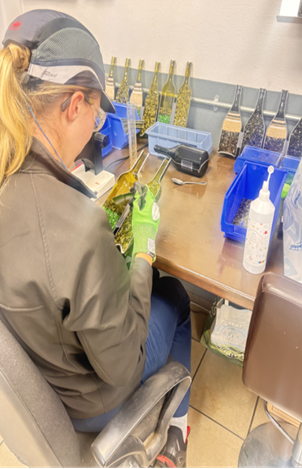
Rebecca Beacom, a three-year placement student with Encirc, was tasked with raising awareness across the company around Encirc’s ambition to increase recycled glass material in their products and inspire colleagues to continue recycling glass in the best ways!
“Unfortunately, a lot of glass containers are placed in co-mingled bins. these are less likey to reach us for use in our products. when bottles are placed in bottle banks, these are more easily obtained as they are collected and sorted by local processors for use in our batch. glass is infinitely recyclable!”
Theresa Clarke, Environmental Manager
Objectives
Rebecca had 2 main objectives:
- Raise awareness around how the organisations raw materials impact upon biodiversity.
- Promote use of bottle banks to increase local cullet supply, and thereby reduce need for mined raw materials.
Baseline
Prior to Rebecca’s project, approximately 10% of employees working in Batch and Furnace department were aware of bottle ingredients.
No visitors to the site would have seen a visual display illustrating glass bottle ingredients and how this relates to biodiversity.
Design and Mitigation Measures
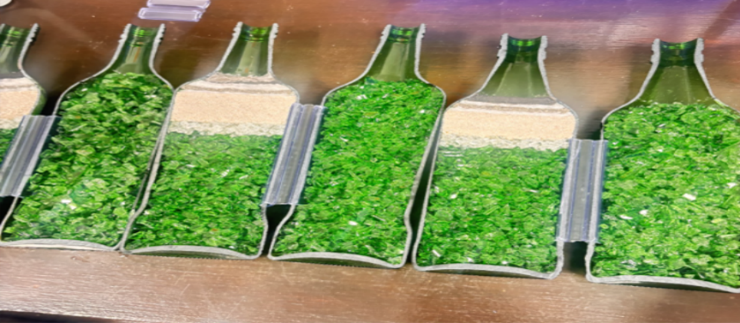
Rebecca designed a visual display to illustrate the percentage breakdown of raw materials in coloured and colourless glass.
Rebecca cut glass bottles in half, using one side to show the current ingredients and cullet percentage, and the other to show target cullet percentage. The aim is to increase cullet to nearly 100%.
To minimise any environmental impacts of the project, a small amount of low-VOC glue with non-toxic ingredients was used to create the visual display. Shelving for the display was designed and created using scrap material by Fergal McElroy, a Batch and Furnace Operator at Encirc. Signage for the display was made by a local company, situated 2-miles from the factory.
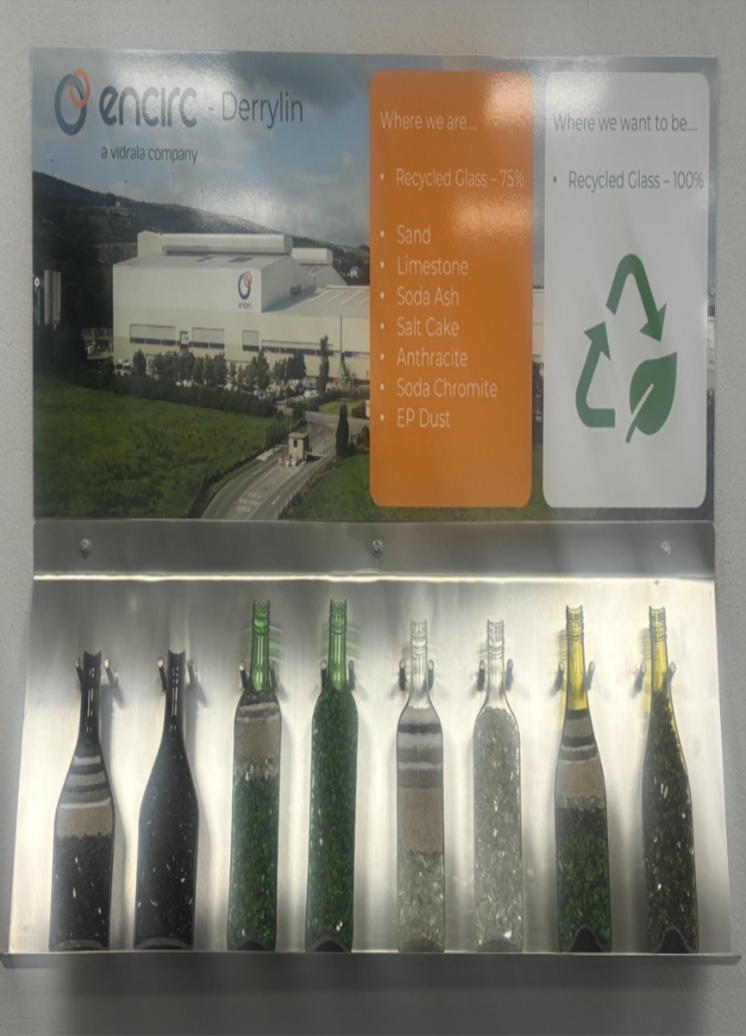
The final display can be seen above.
Impacts and Outcomes
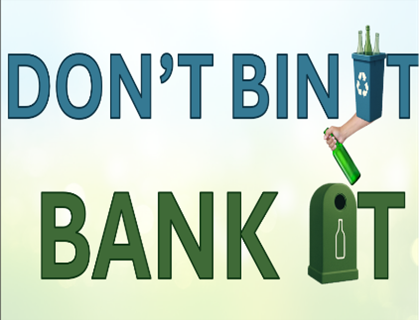
The visual display is located in the hot-end laboratory. All visitors, including school groups, customers, supply chain partners and other organisations, are given a tour of this area. Seamus Corrigan, the hot-end laboratory expert, used the display to explain current bottle content vs target cullet percentage. Seamus always explains the importance of recycling and how it is better to “BANK IT, NOT BIN IT!”. Awareness around how increasing recycled glass in the batch and thereby the need for raw materials will reduce mining and minimise negative impacts on biodiversity has therefore increased.
How BITC helped Encirc
BITC’s Business and Biodiversity Charter has been an integral part of understanding our upstream and downstream impacts on biodiversity, and has provided a framework for how to manage them and their associated risks.