

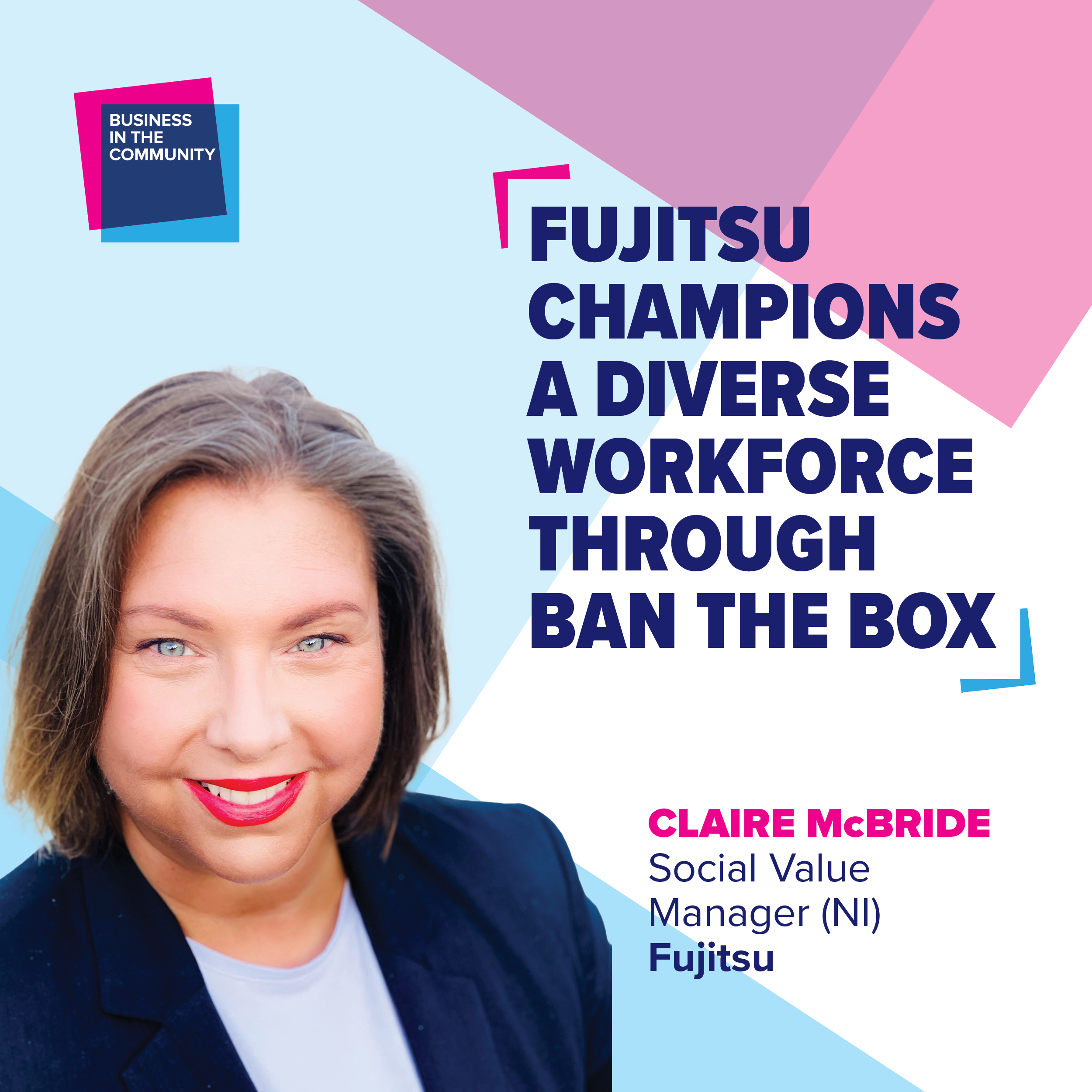
Fujitsu champions a diverse workforce through Ban the Box
by Claire McBride, Social Value Manager (NI), Fujitsu
Q: Please tell us a bit about yourself – how did you come to be in your role, and what does your organisation do?
A: Fujitsu is a global IT services company headquartered in Japan and employs 124,000 people globally. We provide everything from hybrid IT, networks and business applications to emerging technology. In Northern Ireland, we employ more than 600 staff based in Belfast and Derry/Londonderry to support critical national infrastructure for our public sector clients across the UK. As a responsible business, we are committed to supporting individuals and communities. As Social Value Manager, I focus on delivering the social value commitments associated with our contracts and manage volunteering opportunities for our staff. Most recently we have supported justice system reforms and championed the adoption of fair employment practices.
Q: What inspired you to champion the Ban the Box campaign? How does it align with your organisation’s values?
A: Fujitsu’s ethos is deeply rooted in equity, diversity, and inclusion. Ban the Box resonated with us as a natural extension of our core values. Workforce skills are essential to support regional productivity and economic growth. With employers facing a skills shortage, enabling people with convictions to access meaningful employment opportunities supports business growth.
Q: How has removing the traditional checkbox asking about criminal records from job applications impacted your organisation?
A: The initiative provided an opportunity for us to review our recruitment processes from a different perspective, where applicable. It’s been particularly impactful in broadening our engagement with underrepresented groups and fostering a culture of openness and opportunity. Championing this initiative aligns with our goal of building diverse teams that reflect the society in which we live. It also enables us to deliver IT solutions that are fit for purpose, and accessible to all.
Q: You are currently involved in a pioneering business-led IT academy that will be delivered in the Northern Ireland Justice system. Why did you feel compelled to participate, and what benefits do you foresee?
A: We saw this academy as an opportunity to drive systemic change. Participants will engage in hands-on learning that gives them real-world experience in STEM areas. This practical approach not only builds an individual’s level of confidence, it also enhances problem-solving skills, critical thinking and creativity, positioning them for long-term employment in a digital-first economy.
Q: What advice would you give senior leaders or organisations considering Ban the Box or a business-led academy?
A: Leadership requires empathy, aspiration, and trust. Initiatives like this encourage organisations to consider how they create a sustainable workforce. Bringing about systemic change is a challenge and I’d recommend starting with a small pilot programme, be clear on how you are going to measure success, monitor the impact, and share the outcomes. Collaboration across industries amplifies the collective impact.
Q: What social impacts does Ban the Box and broader employability academies for people with convictions bring?
A: These initiatives help break down barriers and rebuild lives. Ban the Box offers employers an opportunity to attract talent from a different demographic and benefit from a diverse workforce. The ripple effect extends far beyond the workplace, touching families, and communities bringing about societal changes that reduce reoffending.